Fill-Ins · Word Fit Puzzles
- 4.7
- Rating
- 1.00M
- Installs
- Free
- Price
 Analysis by App-foxy
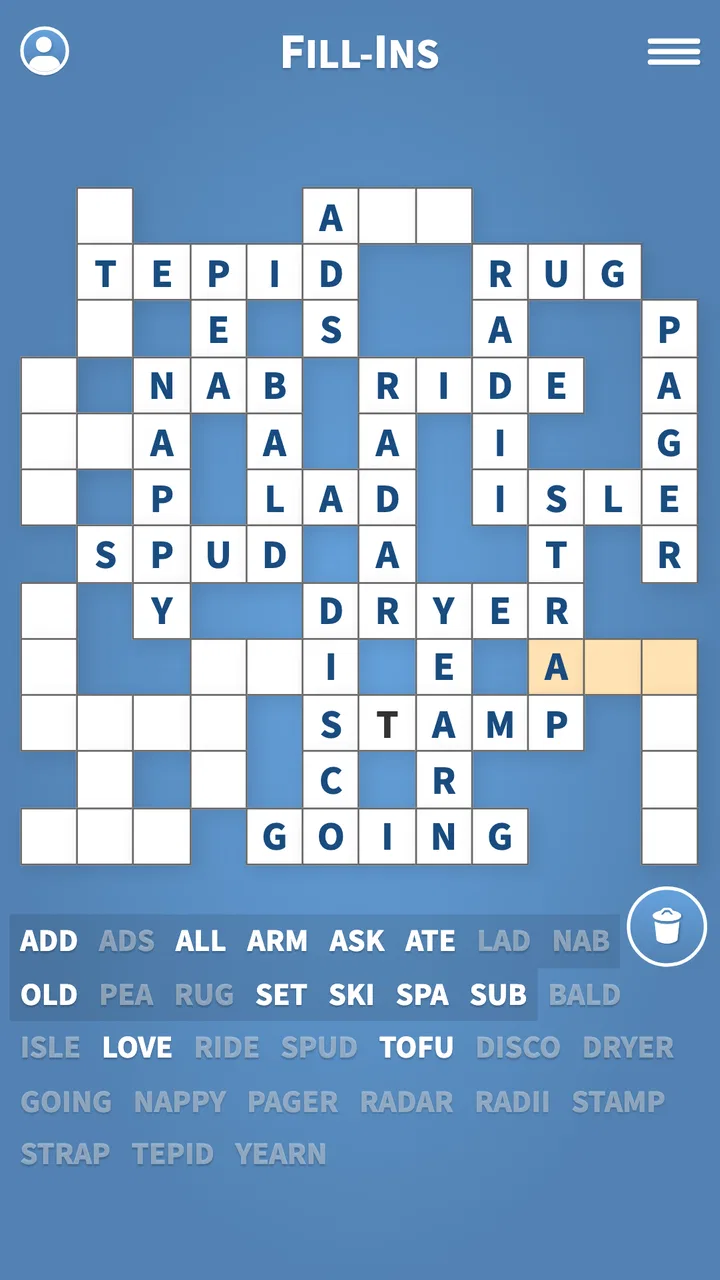
I spent time with Fill-Ins as a quiet word game rather than a fast, competitive challenge, and that distinction matters. Its basic idea is easy to understand: fit the supplied words into a crossword-style grid until every space is complete. The appeal comes from the small decisions between those obvious placements, especially when several words share similar lengths or letter patterns. I found it most enjoyable when I wanted something focused but low-pressure, the kind of game that can fill a short break without demanding constant attention.
This is a free word game from Razzle Puzzles, aimed at everyone and available for Android devices running at least Android 6.0. It has been around since September 27, 2016, and the current version is 1.49. Its audience is substantial, with over a million installs, a 4.7 average from around sixteen thousand ratings, and roughly four thousand four hundred written reviews. Those figures suggest a well-established puzzle rather than a new experiment, but they do not replace personal testing: the real question is whether this particular style of word fit puzzle suits the way you like to play.
How the word-fitting format feels in everyday play
I find the word-fitting format most satisfying when I treat the grid as a set of connected clues rather than a row of empty spaces. In this section, I’ll look at how that changes the pace of an ordinary session and why a quick scan before placing anything can save time. That same careful approach also helps explain what happens when I play for longer.
You May Also Like

 Blood Strike: 2.5 Anniversary
Blood Strike’s Loadouts Turn Every Drop Into a Tactical Gamble
A close look at Blood Strike’s custom loadouts: how fast access to signature weapons reshapes its battle royale rhythm, rewards preparation, and narrows the gap between fights.

 Pandora - Music & Podcasts
Pandora’s Music Is Easy to Start, but Harder to Recover
Pandora’s strength is its low-effort path from a seed to a station. Its weak spot is how much confidence it asks you to place in connection, setup, and quiet recovery.

 8 Ball Pool
 Is Built on Rivalries, Rematches, and Routine
A close look at the rivalries, rematches, shared routines, and unanswered safety questions that turn a quick pool match into a persistent mobile community.

 Samsung Music
’s Quiet Strength Is Playing What You Already Own
Its reach comes less from spectacle than from dependable access to a personal library. That simplicity is both the app’s strongest retention engine and its ceiling.

 AccuWeather: Weather Radar
AccuWeather Review: A Quick, Clear Forecast for Everyday Decisions
For everyday plans, the best forecast is the one you can understand quickly. AccuWeather makes rain timing, radar, and local conditions easy to act on, with a few trade-offs.

 Hill Climb Racing
Why Hill Climb Racing Still Turns Crashes Into One More Run
A tiny car, a bumpy hill and one more upgrade: Hill Climb Racing keeps resurfacing because its simple chaos makes every near-miss feel personal.
More From Our News Desk



A gentler alternative to clue-heavy crosswords
The central difference between Fill-Ins and a traditional crossword is that you are not primarily solving clues. You receive words and work out where they belong in the grid. That changes the mental rhythm completely. Instead of searching memory for a definition, I look at word length, crossing letters, and the shape of open spaces. It feels closer to arranging pieces logically than answering trivia questions.
That makes the game approachable for players who enjoy crosswords but dislike obscure references or clues that depend on specialist knowledge. It also means experienced crossword solvers may initially find it less expressive. There is no clever clue wording to decode and no satisfying moment when an elusive fact suddenly comes to mind. The reward is in narrowing possibilities until the board becomes consistent.
The format works especially well when I am tired. I can begin with the most distinctive long word, place a few obvious entries, and let the crossing letters guide the harder choices. A short word that looks interchangeable at first can become fixed once one or two neighboring spaces are filled. The best boards create a steady chain of small deductions rather than one dramatic breakthrough.
Why the grid encourages a careful first move
My most useful habit was resisting the urge to place every word as soon as it seemed possible. A word may fit by length in more than one location, but an early guess can make the rest of the grid look confusing. I now start with entries that have unusual letter combinations or lengths, then use them as anchors. After that, I check the crossing positions before committing to shorter, more common words.
This is a simple technique, but it changes the experience from trial and error into controlled deduction. When I reach a dead end, I can identify the assumption that caused it instead of randomly moving words around. I also find it helpful to scan the whole board before making a move. The layout often reveals a nearly complete section, and solving that area can provide letters for a more difficult corner.
Another practical approach is to separate certainty from possibility. I treat a placement as reliable only when its crossings support it, while keeping length-only matches in mind without mentally treating them as finished. That prevents one attractive guess from taking over the puzzle. For a casual game, this level of discipline may sound excessive, but it is exactly what keeps the harder boards satisfying instead of frustrating.
A realistic short-break scenario
I can easily imagine using this during a lunch break or while waiting for an appointment. I would open a puzzle, solve the obvious entries, and stop after making meaningful progress rather than feeling forced to finish immediately. Because the activity is based on a static grid and word placement, it suits interrupted play better than a timed word scramble. If I need to put the phone away, I can return with the same visual problem in front of me instead of having to rebuild a rapidly changing round.
That said, the game is not ideal when I want a burst of energy. It does not provide the same immediate excitement as a word search, an anagram race, or a game built around quick rounds. Its pleasure is gradual. I would choose it for concentration and decompression, not for a noisy commute when I want constant stimulation.
What progress feels like without turning it into pressure
Fill-Ins gives me a sense of progress through completed grids and improved solving habits rather than through a story or character system. That is both its strength and its limitation. I can measure my progress by noticing that I make fewer speculative placements, recognize useful letter patterns sooner, and recover from mistakes more calmly. The game rewards better observation, even when it does not announce that improvement with elaborate presentation.
For some players, that quiet structure will be refreshing. There is no need to manage a long narrative, maintain a collection, or keep up with a complicated daily routine. For others, the lack of a broader progression layer may make the experience feel repetitive after extended sessions. If you need unlockable worlds, dramatic objectives, or a strong sense of personal achievement outside the grid, a different word game will probably hold your attention longer.
I also think the format naturally limits unhealthy pressure. A puzzle can be challenging without making me feel that I have lost a race. I can pause, reconsider, and return later. That makes it suitable for relaxed solo play and for people who prefer games where the main opponent is the puzzle itself.
Fairness when the challenge gets difficult
The fairness of a Fill-Ins puzzle depends mainly on whether the word list and grid provide enough crossing information to support deduction. When several entries are clearly constrained, the experience feels honest: I am using evidence, not guessing what the designer had in mind. When a board leaves many short words open at once, the challenge can feel less elegant because multiple placements may look plausible until later.
That is an important trade-off in this genre. A difficult grid is not automatically a better grid. I prefer difficulty that comes from interacting constraints, where one solved section unlocks another. If the challenge instead comes from repeated ambiguity, I am more likely to pause and return later. Players who dislike uncertainty should know that word familiarity can also affect perceived fairness. A common word may be obvious to one person and unexpectedly unfamiliar to another.
My advice is to judge a difficult board by the quality of its available evidence. Look for the longest entries, compare repeated letter positions, and inspect crossings before deciding that the puzzle is impossible. If several candidates remain, leave the area alone and solve elsewhere. Often the missing letter arrives from a completely different section. This workflow is more reliable than forcing a guess just to make the grid look busier.
Spending and the practical purchase question
The game is free to download, which makes trying it straightforward. I could evaluate the core word-fitting idea without committing money first. That is particularly useful here because the format is specific: people who love clue solving may not enjoy arranging supplied words, while fans of logic puzzles may find the transition immediately comfortable.
I would still approach the spending question carefully rather than assuming that free means frictionless. The available product details establish that the game is free, but they do not give me a basis for describing optional purchases, advertising behavior, subscriptions, or particular payment prompts. I would not treat any of those as confirmed features. Before paying for anything inside a game, I would read the exact on-screen description and check the platform purchase confirmation, especially if a child might use the device.
From a value perspective, the strongest reason to try it is the format itself. If you enjoy word placement, a free starting point is enough to discover whether the solving loop works for you. If you are looking for a completely defined spending model, I would make that decision from the current in-app screens rather than from assumptions based on other puzzle titles.
Competitive fairness and playing without comparison
This is not the kind of game I would choose for head-to-head competition. Its appeal is personal concentration, and the meaningful comparison is with my own solving process. That can be a positive feature for anyone who finds leaderboards stressful or dislikes games that turn every session into a performance test.
At the same time, players who need social goals may find the experience limited. A friend cannot easily help with the exact same mental process unless both people are looking at the same board, and the satisfaction comes from private deduction rather than public recognition. I see it as a good companion game for a quiet routine, not as a substitute for a competitive word arena.
There is also a fairness advantage in the absence of a need to outspend another player, at least in the basic decision to download and play the free game. I would not claim more than that, because purchase mechanics are not established here. The sensible conclusion is narrower: this title is best evaluated as a solo puzzle, where progress depends on reading the grid rather than reacting to another player’s speed.
Who will get the most from it
I would recommend it to people who enjoy crosswords but want to remove the clue-solving barrier, to casual players who like logic problems, and to anyone who prefers a game that can be paused naturally. It is also a good fit for word learners who want to notice spelling patterns in context, although I would not use it as a formal vocabulary course. The game can expose me to words I do not immediately recognize, but its main task is placement, not explanation.
It suits patient players better than impulsive ones. The best results come from checking crossings, keeping uncertain options separate, and accepting that one stubborn area may need to wait. If you like making a plan and revising it when new evidence appears, the format has plenty to offer.
I would skip it if your ideal word game is built around clues, definitions, rapid anagrams, or a strong narrative. I would also look elsewhere if you need detailed learning tools, a multiplayer focus, or a highly visible achievement system. The simple design is intentional, but simplicity can feel sparse when you want more than the puzzle board itself.
Small limitations that affect long sessions
The same structure that makes the game accessible can make extended sessions feel similar. Every puzzle asks me to perform variations of the same placement-and-crossing process. That consistency is comforting in short visits, but it may become predictable if I play for a long time without a break.
Another limitation is that the game relies heavily on my own tolerance for uncertainty. When I cannot distinguish between two possible placements, there is no clue-based explanation to rescue me. I have to use the grid, rethink earlier choices, or step away. Players who prefer explicit hints or educational feedback may find this less supportive than a clue-driven crossword app.
The visual simplicity also places more responsibility on the puzzle construction. A well-balanced board feels clever; a less cooperative one can feel like a pile of unresolved possibilities. I would not judge the entire game by one awkward session, but I would pay attention to whether the challenge usually feels deductive rather than arbitrary.
Device suitability and starting expectations
The minimum operating-system requirement of Android 6.0 makes the game accessible to a broad range of Android users, including people who do not keep a current flagship phone. I would still make sure the device has enough free space and that the store page matches the operating system before installing, as ordinary compatibility can change with future updates.
The age rating is Everyone, which fits the nonviolent, word-focused nature of the experience. That does not mean every setting is automatically appropriate for every child, particularly where device purchases or general screen-time rules are concerned. For a family device, I would use the platform’s purchase controls and let a child play with guidance until I had checked the current in-game experience myself.
On iOS, I would verify the current App Store requirements separately before downloading, since operating-system support can differ between platforms. The game’s identity is clear enough to search for by its name and developer, Razzle Puzzles, but I would still check those details to avoid selecting an unrelated title.
What I would check before committing to regular use
My first test would be simple: play several boards at different times of day and notice whether the difficulty feels like a pleasant stretch or a repeated source of guesswork. I would also see how comfortably I can pause and resume, because that determines whether the game belongs in my short-break rotation.
Next, I would pay attention to the word list. If I regularly encounter unfamiliar entries, I would decide whether that adds interest or makes the puzzle feel inaccessible. I would keep a note of new words only if I enjoyed that side effect; otherwise, I would treat the game as a logic exercise and judge it by the quality of its crossings.
Finally, I would review any purchase screen before confirming anything. The title is free, but responsible spending requires reading the exact offer rather than guessing what it contains. That approach keeps the decision grounded in what is actually shown on the device and avoids confusing this game with monetization systems used by other puzzle apps.
My trust verdict after weighing the trade-offs
Fill-Ins earns my recommendation as a focused, low-pressure word puzzle, especially for someone who likes crossword grids but does not want to solve clues. Razzle Puzzles keeps the concept direct, and the established audience, strong average rating, and million-plus installation milestone make it an easy title to consider rather than an obscure experiment. More importantly, the underlying loop has enough depth to reward careful placement instead of random tapping.
I would not call it the best choice for every word-game fan. Its quiet solo structure will not satisfy players who want competition, story, or constant novelty, and difficult boards can test your patience when several words appear to fit. The free entry point makes experimentation sensible, but I would keep purchase decisions tied to the exact information displayed in the app.
My bottom line is simple: choose it for thoughtful word placement, not for spectacle. If you enjoy building certainty one crossing at a time, it can become a dependable companion for short breaks and calm evenings. If you need clues, social rivalry, or a richer progression system, I would spend your time on another word game instead. For the right player, though, this straightforward format is precisely why it works.
FAQs for Fill-Ins · Word Fit Puzzles
01What is Fill-Ins · Word Fit Puzzles and how does it work?
Fill-Ins · Word Fit Puzzles is a word-based puzzle game where players fill a grid with words from a given list. The challenge lies in fitting all words correctly without overlapping or leaving empty spaces. It’s an engaging way to improve vocabulary and problem-solving skills, accessible to players of all ages.
02Is Fill-Ins · Word Fit Puzzles available for both Android and iOS devices?
Yes, Fill-Ins · Word Fit Puzzles is available for download on both Android and iOS platforms. Users can find it on Google Play Store for Android devices and the Apple App Store for iOS devices, ensuring a wide range of compatibility for different smartphones and tablets.
03Are there any in-app purchases or ads in Fill-Ins · Word Fit Puzzles?
Fill-Ins · Word Fit Puzzles is free to download and play, but it may contain in-app purchases and ads. These purchases typically offer additional puzzle packs or remove ads for an uninterrupted experience. Users can choose to enjoy the game for free or enhance their experience with these optional purchases.
04What are the main features of Fill-Ins · Word Fit Puzzles that enhance the gameplay?
The app offers a variety of features such as multiple difficulty levels, daily challenges, and themed puzzles to keep the gameplay fresh and exciting. It also includes hints and an intuitive interface, making it easy for both beginners and experienced players to enjoy the game.
05Is an internet connection required to play Fill-Ins · Word Fit Puzzles?
No, an internet connection is not required to play Fill-Ins · Word Fit Puzzles. Users can enjoy the puzzles offline, making it a perfect choice for commutes, travel, or any situation where internet access might be limited. However, an internet connection may be needed for updates or accessing additional content.
Pros
- Engaging puzzles boost vocabulary skills.
- User-friendly interface makes navigation easy.
- Offline mode available for on-the-go play.
- Regular updates with new puzzle content.
- Lightweight app that runs smoothly on devices.
Cons
- Limited hints may frustrate beginners.
- Ads can interrupt the gameplay experience.
- No multi-language support for global users.
- In-app purchases might feel necessary.
- Repetitive puzzles can reduce long-term appeal.

Fill-Ins · Word Fit Puzzles
Gallery